
Not Getting Dumber
The Linguistic Forge That Built the Minds of the Founding Fathers

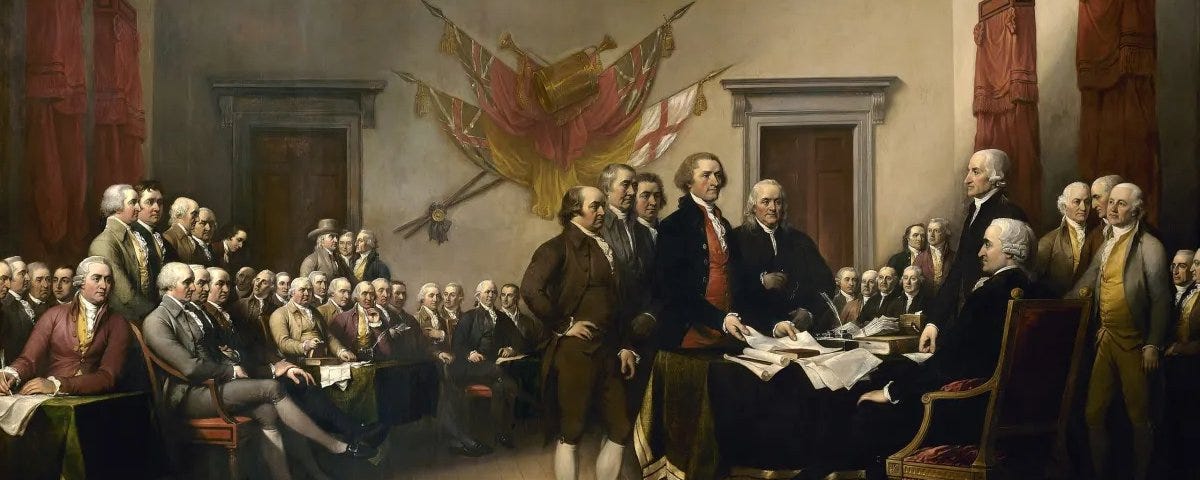
If we wish to retain the sovereign rights and freedoms that the Founding Fathers carved out of the world—not as inherited trinkets, but as living, defensible ground—we must first restore to ourselves the very linguistic sophistication that enabled them to conceive and secure those freedoms in the first place. They didn’t stumble into liberty through slogans or sentiment. They wrote, debated, and persuaded their way into it, using sentences that could hold a dozen qualifications, balance competing principles, and bind abstract philosophy to practical governance. Their words weren’t decoration; they were the tools of self-rule. Without that same sophistication—without the ability to write, read, and think in layered, complex prose—we’re citizens who can only grossly imagine rights, not articulate, defend, or extend them. The forge that made the Founders sovereign thinkers is the same one we must re-enter if we intend to remain a sovereign people.
We hear it constantly: people are getting stupider. Social media is a sewer of half-thoughts, political discourse is reduced to slogans, and even bestsellers read like they were written for middle school. The complaint feels intuitive. Yet the evidence says the opposite. Our species’ cognitive hardware—the raw neural capacity measured by IQ tests—isn’t degrading. It has, for most of the past century, been improving. What’s collapsed isn’t intelligence itself, but the linguistic training that once turned ordinary young minds into instruments capable of multidimensional thought, layered reasoning, and world-shaping clarity.
This isn’t nostalgia. It’s a measurable shift in the environment that shapes cognition. From the Scottish Enlightenment through the American Founding, English prose—and the classical languages that undergirded it—was rich, periodic, and syntactically demanding. Sentences routinely stretched 40 to 70 words, nested with subordinate clauses, hypotheticals, qualifications, and logical chains that forced readers to hold multiple ideas in tension. Greek and Latin, the languages of Plato, Aristotle, Cicero, and Virgil, supplied the same discipline: precision of abstraction, rhetorical architecture, and the habit of seeing reality in layers. That linguistic forge produced men who, in their twenties, wrote pamphlets, drafted constitutions, and debated philosophy at a level that still humbles us. We haven’t lost their potential. We’ve simply stopped using the same forge.
The Evidence: Hardware Stable or Rising, Software Simplified
The Flynn effect shows average IQ scores rising roughly three points per decade across the 20th century in developed nations. Better nutrition, sanitation, schooling, and early cognitive stimulation explain the gains. Recent studies show the effect has slowed or reversed in some Western countries, but the reversal is modest; overall, raw intelligence hasn’t entered free fall. We remain, at the biological level, at least as capable as our ancestors.
What’s changed dramatically is the linguistic environment. Modern readability metrics document a consistent, decades-long simplification of English prose. Average sentence length in political speeches, newspapers, popular literature, and even academic writing has plummeted. Eighteenth-century philosophical and political texts routinely averaged 30–50+ words per sentence; today’s mass-market material averages 14–20 words—a drop of roughly half over three centuries. Flesch-Kincaid grade-level scores tell the same story. The Federalist Papers (1787–88), written for newspaper readers and aimed at persuading ordinary citizens, score approximately 16–17 on the Flesch-Kincaid scale—solid college level. Early presidential addresses and State of the Union messages often reached 15–21 grade equivalents (college to postgraduate). Since the mid-20th century, they’ve fallen to the 6th–10th grade range. The shift wasn’t accidental. Mass literacy, universal public education, commercial publishing incentives, and deliberate policy choices prioritized broad reach over depth. The result: generations raised without routine immersion in the very structures that once trained the mind to think in complexity.
The Difference in Black and White
Statistics are abstract. Syntax is visceral. Consider two passages, both written for a broad, non-specialist audience. First, James Madison in Federalist No. 51 (1788), explaining checks and balances:
“But the great security against a gradual concentration of the several powers in the same department, consists in giving to those who administer each department the necessary constitutional means and personal motives to resist encroachments of the others. The provision for defense must in this, as in all other cases, be made commensurate to the danger of attack. Ambition must be made to counteract ambition.”
Even the shorter first sentence (28 words) contains nested clauses (”to resist encroachments...”), abstract chains (”means... motives... defense... danger”), and a concluding aphorism (”Ambition must be made to counteract ambition”) that compresses a full political theory into four words. The reader is trusted to hold a causal chain in mind.
Now consider a modern passage on a similarly complex political topic—checks on executive power—from a 2023 Vox explainer aimed at educated general readers:
“The president has a lot of power. But Congress can push back. For example, Congress controls the budget. If the president wants to do something big, they might need funding. Without it, many plans stall. This is a basic check.”
The average sentence length has fallen from ~24 words to ~8 words. The subordination has vanished. The abstraction (”the necessary constitutional means”) has been replaced with concrete examples (”the budget,” “funding”). The reader is never required to track a relationship across more than two clauses. One passage trains you to think in systems; the other trains you to recognize bullet points.
Or take a concrete economic comparison. In 1776, Adam Smith wrote:
“It is not from the benevolence of the butcher, the brewer, or the baker that we expect our dinner, but from their regard to their own interest. We address ourselves, not to their humanity but to their self-love, and never talk to them of our own necessities but of their advantages.”
Forty-one words. Subordination. Abstract nouns: benevolence, interest, humanity, self-love, necessities, advantages. A complete inversion of moral expectation in a single, balanced period.
In 2023, a Bloomberg Economics newsletter explained market incentives this way:
“People respond to prices. If something gets expensive, they buy less of it. Sellers see high prices and make more. That’s how supply and demand works.”
Nineteen words total across four sentences. Every sentence is subject-verb-object. The only abstract noun is “supply and demand,” which is invoked as a label, not unpacked. The Bloomberg piece isn’t wrong. It’s simply thin. And millions of educated professionals read such prose daily, never encountering a sentence that demands they hold a qualification, a concession, and a conclusion in their head simultaneously.
The Founders Weren’t Demigods—They Were Linguistically Forged
The men who founded the United States weren’t genetic outliers or divinely gifted. Many were startlingly young. Alexander Hamilton was nineteen when he published his first major political pamphlet in 1774. James Madison was twenty-five when he helped frame the Virginia Plan and thirty-six during the Constitutional Convention and Federalist Papers. Thomas Jefferson was thirty-three when he drafted the Declaration of Independence. What set them apart wasn’t superhuman IQ but an education and public discourse saturated in linguistic richness.
From childhood they drilled in Latin and Greek. Rhetoric, disputation, and classical texts weren’t electives; they were the curriculum. They read Locke, Hume, Smith, and Montesquieu in the original dense prose—prose whose Flesch-Kincaid demands and sentence architecture far exceeded anything in today’s public square. Daily newspapers, pamphlets, and sermons mirrored that style. Consider Hamilton at nineteen, already writing with nested qualifications, balanced antithesis, and logical escalation that modern metrics would flag as college-level. Or Madison in Federalist No. 10, sustaining an 80-word sentence that layers psychological insight, historical observation, and political theory—precisely the multidimensional scaffolding that today’s 15–20-word average sentences are incapable of.
This isn’t ornament. The syntax itself trains the mind to track contingencies, anticipate objections, and hold abstractions in dynamic tension—the very “multidimensionality” modern simplified prose rarely requires.
The Classical Languages and the Intentional Narrowing
English was never the sole forge. Greek and Latin provided an older and deeper architecture. Founders read Aristotle’s Politics and Cicero’s De Officiis in the original, internalizing periodic sentences and precise philosophical vocabulary that English later absorbed. Yet modern education largely abandoned compulsory classical language training after the early twentieth century. The decision was framed as democratic progress—make knowledge accessible to all. The unintended consequence was the atrophy of the very linguistic tools that once enabled ordinary citizens to engage complex ideas at depth.
A Necessary Counterargument
The rejoinder writes itself: “Long, periodic sentences exclude people. The Founders’ audience was a tiny, propertied, male elite. Modern readability is democratic.”
This confuses two different things: access to information and cognitive training through syntax. Yes, universal literacy and plain-language laws have rightly expanded who can read. But we’ve collapsed the distinction between entry-level texts (which we all need) and growth-level texts (which we all also need). A sixth-grader can read a short declarative sentence. But a sixth-grader who only reads short declarative sentences will never develop the neural architecture to follow Madison’s argument about faction. The Founders’ world was narrow, but its linguistic forge was open to any apprentice who could master it. Our world is broad, but we’ve melted down the forge for scrap.
The Path of Restoration
The good news is that the solution is embarrassingly straightforward and entirely within our power. We don’t need to wait for educational bureaucracies to reverse course. We can restore the forge ourselves.
Read the classics in their own words—not modernized translations or Cliff’s Notes. Tackle Locke’s Essay Concerning Human Understanding, Smith’s Theory of Moral Sentiments, Hume’s essays, the Federalist Papers, and the great Greek and Latin texts in editions that preserve their syntactic architecture. But don’t just read. Perform this exercise nightly for three months:
Take one long sentence from Federalist No. 10 or Smith’s Theory of Moral Sentiments.
Copy it by hand.
Diagram its clauses (subject, predicate, subordinate clause, qualification).
Rewrite it in your own words, preserving the structure—not just the meaning.
Finally, write an original sentence of 40+ words on a current political issue, using at least two subordinate clauses and one qualification (e.g., “although,” “nevertheless,” “on the condition that”).
This isn’t pedantry. It’s weightlifting. Hamilton and Madison didn’t perform different exercises; they simply never stopped performing them. Their fluency was forged repetition. The discomfort you feel is the muscle growing back.
We’re not becoming less intelligent. We’re simply no longer being trained to think like the men who, in their twenties, built a republic on ideas. Restore the linguistic environment that once forged such minds, and the feats of thought and speech will follow—not because we’ve suddenly grown smarter, but because we’ll finally be using the full cognitive toolkit our species has always possessed. The Founding Fathers were proof. You can be the next.
This is a phenomenal autopsy of what I’ve started calling "Schema Collapse."
The institutional justification for gutting the linguistic forge has always been framed as a moral imperative: accessibility. We were told that simplifying prose and flattening syntax was an act of democratization. But as you brilliantly pointed out, collapsing the distinction between an entry-level text and a growth-level text isn't democratization—it’s cognitive sedation.
When you replace a 50-word Madison sentence that forces the reader to hold competing abstractions in tension with an 8-word bullet point, you aren't just making it easier to read. You are actively atrophying the neural architecture required to think in systems. An electorate that can only process subject-verb-object syntax physically cannot dismantle a complex bureaucratic or corporate cartel; they lack the multidimensional scaffolding required to even perceive it.
The discomfort of reading high-density text isn't a sign of poor communication; it's the friction of the cognitive muscle growing back. Thank you for putting words to the exact reason why we must refuse to "dumb down" our writing for the algorithm. The forge was never lost, it was just melted down for scrap. We have to build it again ourselves.
Another fantastic cognitive weapon (and exercises for continued development).