

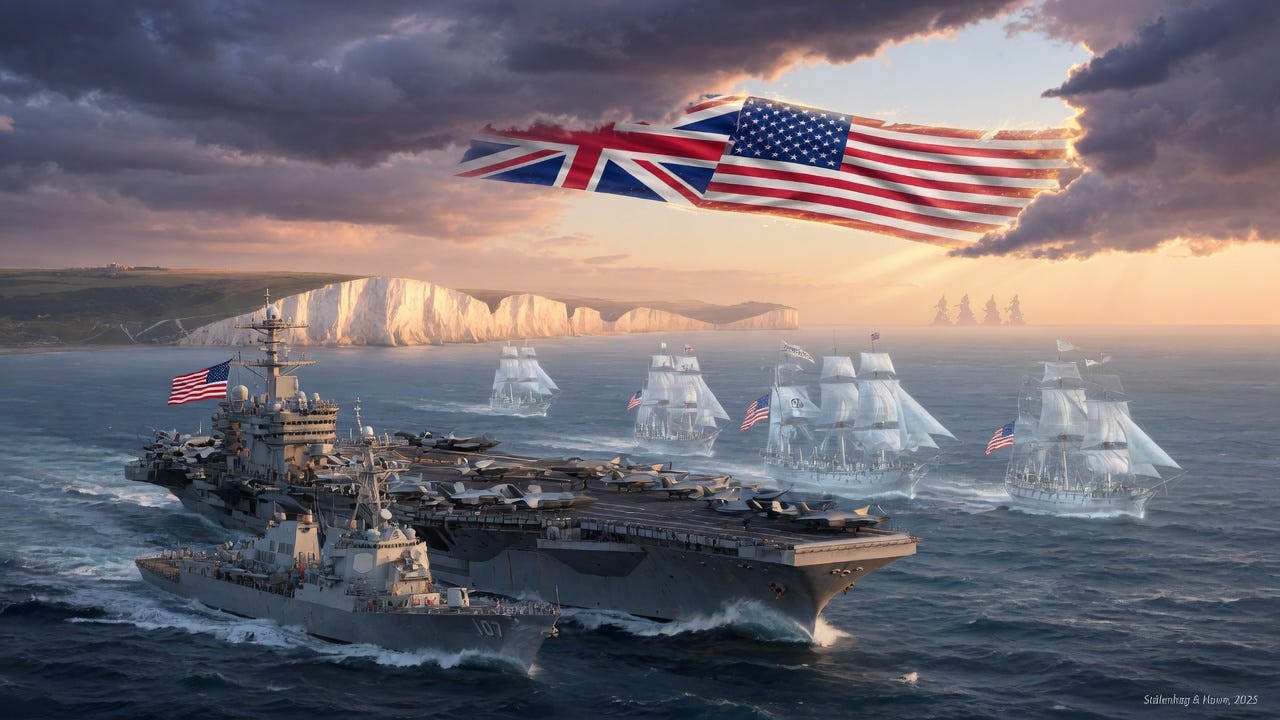
The 400-Year English Civil War didn’t begin in 1642, nor did it end in 1651, 1688, or 1776. It mutated across the saecula, shifting its theater from fields and continents to the one domain where English power has always been absolute: the sea. The final crisis—English Civil War 3.0—is now being waged not on land but in the straits and shipping lanes of the world. This is the inevitable geography of an intra-English schism projected onto the maritime domain.
This conflict is driven by what I term the Financialist Regime. This refers not to the British people, but to the specific institutional nexus of commodities pricing, debt-finance, maritime insurance and related market interests embedded in London’s core—the spiritual and operational successor to the Bank of England chartered in 1694. This regime prioritizes the monetization of naval risk and chaos over the stability of maritime commerce. Global flashpoints—from Iran’s reimposed control of the Strait of Hormuz to naval blockades and energy strikes in the Black Sea—aren’t isolated geopolitical spats. They’re symptoms of an unresolved schism.
Peace will remain impossible as long as the original seat of sea power, the British Isles, remains under occupation by the very forces that beheaded Charles I and have never forgiven the Jeffersonian fracture of 1776. To conclude the cycle, restore true English liberties, and secure the global sea lanes, the American-led English-speaking peoples must retake the Isles. This isn’t imperialism; it’s the completion of the unfinished revolution.
I. The Accumulated Verdict of History
To understand the present crisis, one must understand its long, unbroken arc. The war has unfolded in three distinct phases:
Phase 1 (1642–1688): The Regicide and the institutionalization of finance. The judicial execution of Charles I set a precedent for regime continuity that the Restoration of 1660 never fully erased. The Glorious Revolution and the chartering of the Bank of England transformed that schism into a permanent unaccountable financial extraction regime.
Phase 2 (1776–1945): The Jeffersonian Breakout. The American Revolution wasn’t a separate war but Civil War 2.0—a rejection of the 1688 model in favor of republican sovereignty. The Financialist core in London could neither forgive nor forget this defection.
Phase 3 (Post-WWII–Present): The Maritime Projection. Having lost direct imperial control, the regime embedded its DNA into global alliances and turned the high seas into a risk-premium and market manipulation engine of extraction.
We see the headlines today: Iranian gunboats, “strict control” of Hormuz, tankers fired upon, energy infrastructure struck. These aren’t random eruptions. They represent the English branch of the Financialist regime projecting its ancient grievance onto the arteries that carry the world’s lifeblood. The English-speaking peoples invented modern sea power; the Financialist remnant has spent four centuries weaponizing the very domain we were born to command.
The accumulated verdict is clear: every prior fracture left the Isles as the Financialist redoubt. Across nearly four centuries, peaceful coexistence has failed. The only path to closure is Reconquest—and with it, the liberation of every choke point held hostage for profit.
II. Why Peaceful Means Have Failed: The Entrenchment of the Enemy Within the Isles
The Financialist regime never left Britain; it adapted. The post-Brexit theater, the revolving-door governments, the scandals—none of these are signs of a nation adrift. They’re features of a system designed to ensure that political power in Westminster remains too weak or distracted to police the seas effectively.
There’s a direct, observable correlation here: Political chaos in London aligns with spikes in maritime insurance premiums, commodities pricing and market volatility. A weak government can’t guarantee freedom of navigation, which benefits the “Chaos Engine” embedded in the City of London. Instability isn’t a bug of this system; it’s the mechanism that keeps naval escorts expensive and shipping rates high. The City remains the nerve center for this extraction, the same entity that’s never ceased financing chaos for profit.
The “special relationship” has always been an illusion maintained for the benefit of the remnant. When American leaders speak of partnership with London, they’re usually speaking to the very institutions that view Jeffersonian sovereignty as the original sin of 1776. The regime won’t voluntarily relinquish command of the world’s sea lanes. Continued occupation of the British Isles equals endless maritime chaos. Reconquest equals closure. There’s no third option.
III. The Strategic Imperative: Retaking the British Isles as the Keystone to World Peace
Every prior fracture left the Isles as a disposable Financialist HQ. The British Isles aren’t merely a picturesque landscape; they’re the symbolic heart of the English-speaking peoples and the hub for global chokepoint for sea power projection. Retaking them neutralizes the source of the chaos.
The mission is Restoration, not Conquest. We must be precise about the nature of “force.” This is a bifurcated strategy:
Phase A (Non-Kinetic Liberation): This phase is cultural and political. It involves a sovereignty referendum supported by information warfare that exposes the “1688 Fraud” to the English-Speaking Peoples themselves. It relies on awakening the latent Alfred the Great, William Marshal and Jeffersonian elements still alive in the English soul.
Phase B (Kinetic Options - Only if Phase A is met with armed resistance): Should the Financialist networks trigger armed resistance—as they have in every prior phase of this war—kinetic options follow. This doesn’t mean an invasion of British beaches. It means naval interdiction of Financialist command nodes, precision strikes on the infrastructure of the chaos-premium engine, and special operations designed to isolate the center of gravity with minimum harm to the innocent population.
We aren’t coming as invaders. The English peoples are our blood. We’re coming as liberators to finish what our shared ancestors began.
IV. The Choke-Point Liberation: Freeing Sea Traffic Arteries to End the Risk-Premium Chaos and Financial Manipulation
Here lies the concrete, strategic payoff of Reconquest. The Financialist regime’s control of the Isles manifests as engineered instability at the world’s critical sea lanes. The Strait of Hormuz today is only the latest chapter in a four-century pattern: threaten closure, spike the price of energy and insurance, collect the premium, and—crucially—manipulate the markets that depend on the free flow of goods.
The pattern was institutionalized in 1694 when the Bank of England was chartered specifically to finance William III’s naval wars against France. This turned the Royal Navy into a permanent debt-financed instrument of extraction. By the time of the 1956 Suez Crisis, the regime’s post-imperial pivot was complete. Unable to hold the canal by force against Nasser, London shifted its strategy from controlling the chokepoint to profiting from the volatility of its closure.
The clearest modern demonstration remains the 1980s Tanker War. Over 500 commercial vessels were attacked in the Persian Gulf; insurance premiums spiked by hundreds of percent; oil prices swung wildly. But the damage did not stop at the pump. The uncertainty of supply allowed those with advance knowledge of naval movements—namely, the Financialist-aligned trading houses and banks—to game the futures markets, shorting the stability of entire national economies while picking the winners and losers of global industry. While the U.S. Navy conducted Operation Earnest Will to restore freedom of navigation, London’s financial markets profited not just from the insurance premiums, but from the arbitrage of fear itself.
Why does this matter for the British Isles? Because the City of London remains the legal domicile for the vast majority of the world’s maritime insurance syndicates and the clearinghouse for a significant portion of global commodity derivatives. As long as that specific square mile operates under the 1688 DNA, every bullet fired at a tanker in Hormuz or Malaca or the Gates of Hercules et al rings the cash register in Leadenhall Street—and sends a shockwave through the trading algorithms that determine the cost of heating a home in Boise or manufacturing a car in Birmingham. Therefore, retaking the political sovereignty of the Isles is the only way to re-regulate the financial sovereignty of the seas and to end the use of maritime chaos as a tool for market manipulation.
The strategic payoff of Reconquest is immediate and structural. Reasserting unified Anglo-American sea command collapses the artificial risk premiums that inflate energy prices and the shadow premiums that distort capital flows. It ends the ability of a hidden hand to weaponize a strait in order to bankrupt a competitor or enrich a specific fund. Post-liberation joint task forces—US-led, with the restored British Isles as a forward partner—will guarantee freedom of navigation at Hormuz, Malacca, Bab el-Mandeb, Panama, Suez, and the Danish Straits. Not under the hidden Financialist thumb, but under the open command of sovereign sea powers whose interest is transparent commerce, not rigged casino warfare.
The economic dividend is incalculable: lower across the board costs for families, predictable supply chains, and an end to the silent, three-hundred-year tax that’s allowed a few to pick winners and losers through the control of chaos.
V. Victory Paths & Operational Map — From Washington as New Constantinople
The operational blueprint is grounded in the great theorists of English-speaking sea power, most notably Alfred Thayer Mahan. His work The Influence of Sea Power Upon History demonstrated that control of chokepoints and lines of communication determines the fate of nations. The United States absorbed Mahan’s lesson, building a forward maritime posture that rejected the 1688 model in favor of sea command as the guardian of republican freedom.
Our operational map follows this logic in reverse. A sea-power supporting American-led alliance—the United States, Canada, Australia, New Zealand, South Africa and awakened Jeffersonian elements within the British Isles—becomes the restored center of gravity. Naval special operations, information warfare, and economic decoupling across the maritime domain form the modern equivalent of a “Glorious Revolution” turned right-side up. Where 1688 invited a foreign prince to entrench the Bank, we invite our own blood home to dissolve its spiritual successors.
Washington as the new Constantinople isn’t mere metaphor. It’s the logical fulfillment of four centuries of unfinished business. Constantinople stood astride the maritime crossroads of the world, a bulwark of order and commerce on the water. Washington now occupies that role—the place from which sea power can finally be exercised without the hidden hand of 1688 turning every strait into a profit center for perpetual war and market distortion.
Risks exist and must be named. Domestic Hamiltonians in the United States—echoes of the faction that once favored centralized finance over Jeffersonian liberty—may resist the necessary decoupling from London. Empire traps lurk if the mission drifts from restoration to domination. The mitigation is built into the design: keep the mission finite, maritime-focused, and liberation-first.
The risk of failure is Total Burn. This scenario entails the permanent militarization of global shipping lanes, turning the world’s oceans into a toll-road network and a dark pool of financial manipulation controlled by an unaccountable, extra-national class. Victory, conversely, ends the 400-year cycle, secures the oceans, and initiates the next great English saeculum of flourishing.
VI. Call to the English-Speaking Peoples
This is the duty of the sea-power heir: not the conquest of land, but the liberation of lanes—and the restoration of a fair market on the waves. A restored British Isles, free from the 1688 DNA, becomes the forward operating base of peace rather than the back-office of perpetual maritime war and market gaming.
The blood of our ancestors demands reckoning only insofar as we are willing to pay the toll—and suffer the manipulated price swings—for another century. True fraternity among sovereign English-speaking peoples ends the sin of 1649, frees the choke points, and neutralizes the financial levers that have picked winners and losers in the global economy for far too long.
Spread the 400 Year English Civil War series. Demand that leaders recognize the real war is a naval war. Prepare mentally and spiritually for the Reconquest phase.
The seas are calling us home—to lower the price of oil, to secure the passage of goods, to end the rigged game of global finance, and to finish the war where it began: on the water, for the liberty of the global commons. Let us finish it once and for all.
anyone who doubts that a Financialist Regime could exist as such (and probably most everyone in the world doubts that) should just think about deBeers and diamonds and their transnational Cartel that has existed for decades. Except, bringing even that up fails to stir much.
Thank you. 🙏🏻
Brilliant. Keep writing what you ARE writing,
in as many ways as possible.